Building Bunksy and flunking, frankly
Anthony Bourdain urged 22-year-olds to do anything and somehow find a way to travel. To walk in other people’s shoes. I crossed that Rubicon two years ago and there is so much to tell. Experiences and ideas that arise and push you to do more, experiment, to write your own stories. It is this sort of ingenuity and break from the mundane that is supposed to breathe life into life. One day, you’ll be doing interesting things and an apple falls on your head. Hopefully, life-changing and at the intersection of things you’ve always loved.
I’ve spent most of my life in Chennai, out of the same pin code. Travelling solo, meeting people from different walks of life, an open mind and just saying “yes” often have given me some of my best days. While travelling solo, the right hostel is your best friend. An adequate dorm can make or break your entire journey. A good night’s sleep. The right crowd. Helpful hosts. However, the business is cut-throat. As a hostel owner, you’ve gotta nail pricing, markups, group bookings, social expectations, the staff rotations and yet other items I’ll leave out here.
Mise-en-place.
On one of my trips, I found myself looking for a hostel in Shillong, having reached the city around midday from Guwahati and not having booked anything beforehand. Cherry on top, it was a Saturday. I opened all the household-name aggregators but could not find a reasonable stay. I then decided to gamble on the Youth Hostel in Shillong and visited it in person. The main reason was that they don’t list online and don’t confirm availability over the phone. After a night of troubled sleep in shared accommodation with 20 other people, I decided to call it quits and opened the apps the next day. I then chanced upon a small hostel on Booking.com with a single review. The location didn’t check out on Google Maps. The only reason I’d stay at this place was if my present situation forced me to. It did and I took up the stay.
Through my stay, I got to know that this place was relatively new and the owner was working and based out of Mumbai. The whole place ran on his WhatsApp chats. He would get double-booked, guests would extend but it wouldn’t get logged, and there was very little marketing and practically no social scene. On top of this, the owner had to sometimes rely on the kindness of guests to get some tough situations sorted when he was running an errand. Remember, this is a small venture of his that is just trying to get on its feet.
Prior to this, I myself had gotten double-booked out of a bed in Goa and had to arrange alternatives. By now, I had already ruminated on a basic idea of how to spruce up a hostel with new-age property management software (PMS). A better system would help both me (a customer) and the owner. Bunksy would be a deus ex machina for the hostel ecosystem.
This is not just about why a hostel owner wouldn’t go for an existing PMS. Those are a dime a dozen. It’s about why they shouldn’t.
Primarily, I see hostels and hotels as two different spaces. A hotel provides you with a more fine-tuned and private experience whereas a hostel is really about nailing the balance between affordability and getting the essentials right. I also see it as an extension of the experience economy that young people are leaning towards. A very communal experience.
Telling God my plans.
All references to hostels here are references to commercial tourist & backpacker hostels, not subsidised accommodations. I will gladly rant about college hostels and how terrible they are at my first opportunity to do so, but now is not the time.
A hotel tries to optimise RevPAR (Revenue Per Available Room) whereas a hostel has to optimise RevPAB (Revenue Per Available Bed). The allocation happens at a “bed” level and all contention and locking have to be at the same level. Existing hotel-based software fits hostels like a glove. OJ’s glove.
Okay, a quick rendezvous to numbers-hell apropos conventional wisdom. Zostel, The Hosteller, goSTOPS. Every field needs a triumvirate and these are ours. Apart from these, there are smaller groups like Moustache, Madpackers and Joey’s, who are also extending their footprint. Together that’s about 225 hostels.1 Apart from this, there’s a plethora of one-offs and independents, and in total, there are ~1,850 hostels listed online in India.2 So the chains make up 12.2% of all hostels,1,2 leaving the vast majority of hostels independent. There are more hostels that aren’t listed online, leading to a reasonable estimate of ~2,000 hostels.3 The hostel industry has an India-only estimate of annual accommodation revenue of ~₹900 crore (about $100M).4 Globally, India has the most hostels with a 7.6% country-wise share.2
Hostels also bring with them staff and operators. At a minimum, every property needs a property manager, a caretaker and front-desk staff. The space sees a lot of employee turnover and the economic incentive is as ordinary as in other hospitality areas.
The PMS segment is very competitive. You’ve got global players like Oracle OPERA, Cloudbeds, Mews and Yanolja (eZee) followed by smaller, more localised agents. Almost every hostel I’ve stayed in that is already on a PMS uses eZee.
There are two main monetary aspects of a hostel: 1) as cheap accommodation for tourists & backpackers (I’ll collectively refer to them as tourpackers) overlapping with the tourism market and 2) as an extensive social experience overlapping with the experiences market. As many and merry of us have been participating in this experience economy, and having experienced it as a backpacker, I wanted to build something at this intersection.
Premise: treat hostels as first-class citizens and give them what they deserve. This definitely solves a user-facing problem as well. It’s one less bad experience to worry about. At least you know there’s not going to be someone else claiming your dorm. A bare minimum standard, and just getting the basics right. Renting an iron out, getting a returnable locker, booking a lower bunk specifically. Boy, I know I would’ve loved to confirm a lower bunk.
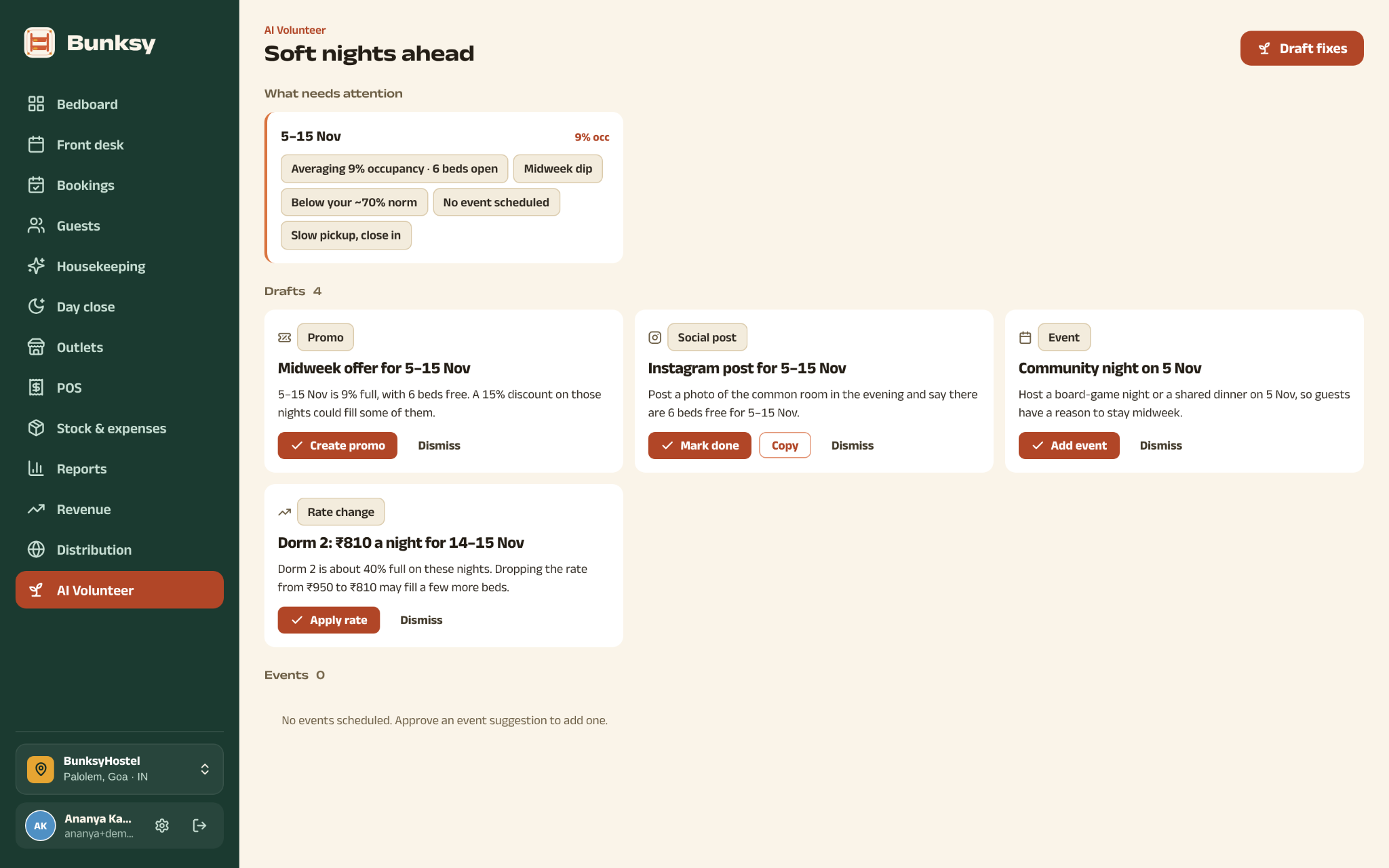
So I did what I do best. I travelled a bit more, spoke to people, and sat down to build. Bunksy would be a hostel-first PMS where RevPAB would be first-class and the primary optimisation variable. The focus would be on getting the pricing and experiences right at bed level with a dynamic pricing algorithm, which factors in upsells, social experiences, seasonality and other magic masala ingredients. There’s a plug-in that would analyse social trends with AI and generate ideas, akin to what a volunteer would think of. Aside from physical experiences, it would also provide social media hints. A reel template here, a story there. Of course, all of this has to look beautiful and functional. Because that’s one thing a PMS never is. Have you ever complimented a PMS for its ingenuity and functionality? Never. That had to change, so I based the theme on Athangudi tiles and patterns native to the Chettinadu region of Tamil Nadu, India.
I spent the last three months building this. Checkout (pun intended) Bunksy yourself: bunksy.arjunmukesh.com
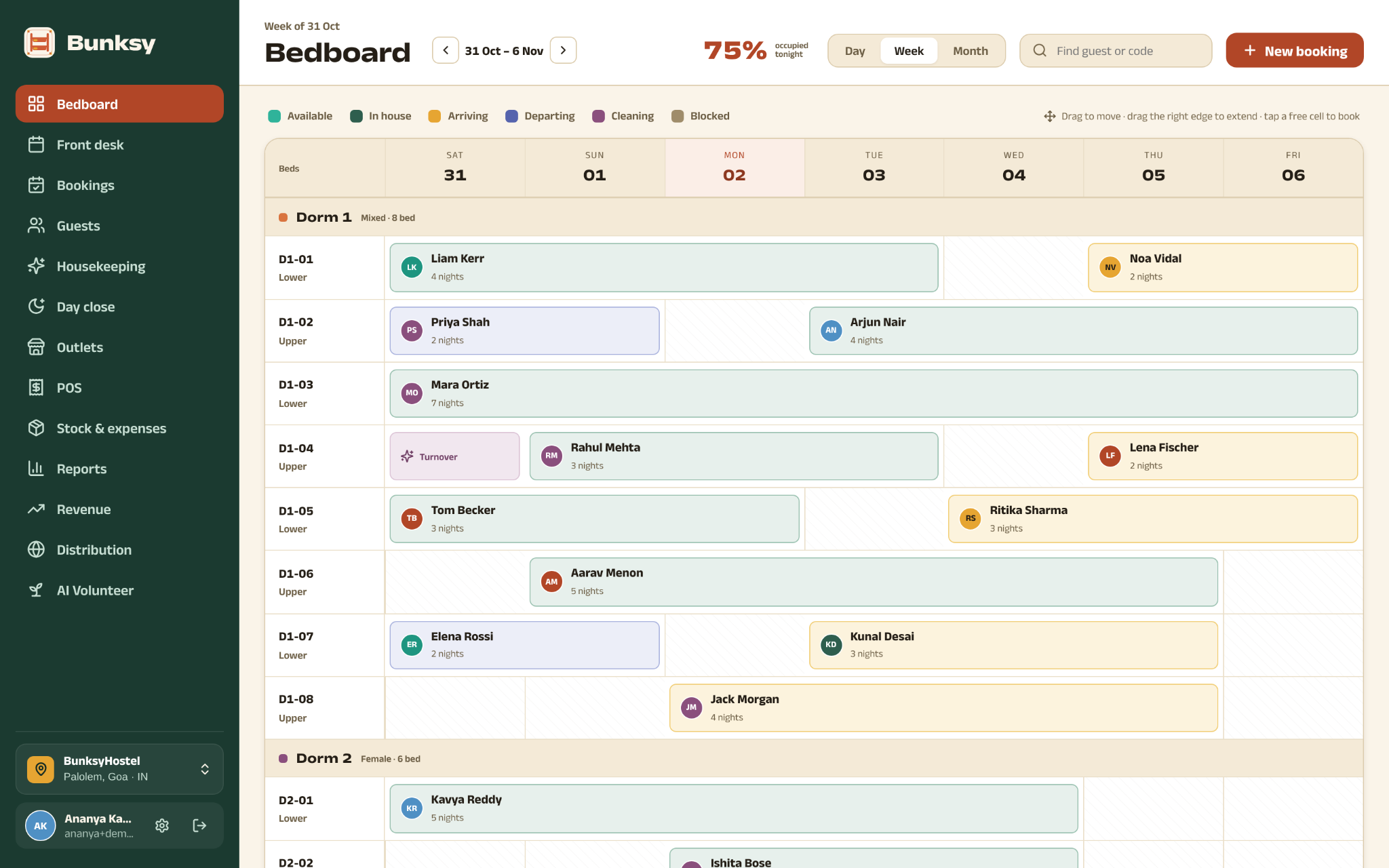
Bunksy is built on React, Express & PostgreSQL. Beds are the fundamental units of inventory. Hostels can cluster them in any configuration and sell them. This allows us to accommodate both privates and dorms without creating conflicting reservations. Multiple customers may contend for the same bed simultaneously. A PostgreSQL exclusion constraint makes overlap impossible for the same bed. Checkout-day boundaries and deadlock detection are handled at the DB level as well. OTA and payment integrations are mocked in the public demo. Fun note about the demo: instead of building a sample hostel each try, you claim one transactionally from a pool of pre-built copies. Replacement is spun up in the background.
The main problems a PMS solves are self check-in, guest folio management, cafe/restaurant integration, invoice management, review funnels, OTA (online travel aggregator) listings. There’s no point in building out all the features in the world if you’re unable to get the data feed from different OTAs in order to list and get bookings. For example, Booking.com runs its Connectivity API, through which PMS and channel managers connect to it. I already knew someone working there and thought it was divine intervention. One call later:
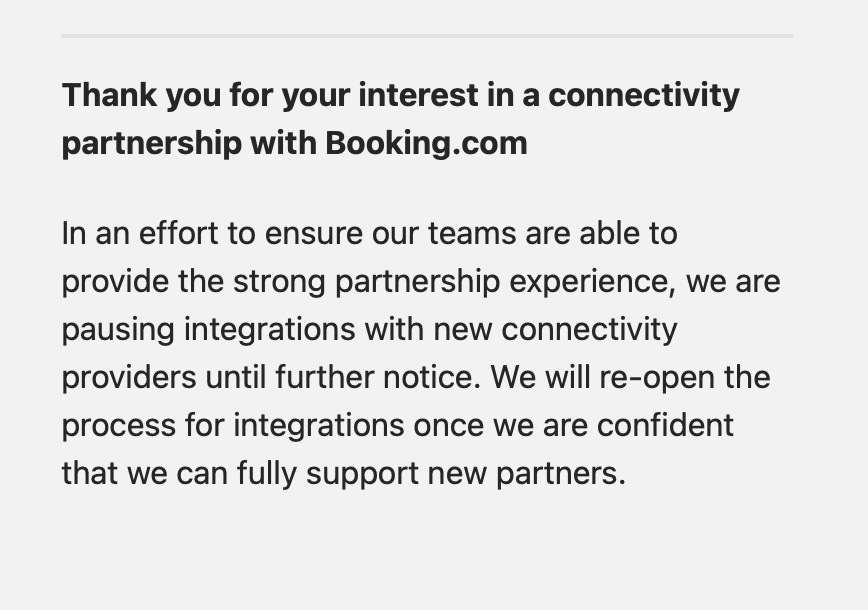
Booking.com paused new integrations.
APIs for use by channel managers are on a case-by-case basis requiring formalities and reaching out to the OTAs. A workaround to this is to instead pay money to an external channel manager and abstract it out of Bunksy. Unfortunately, this does not fit the monetary equations in a cut-throat market.
My bet was that hostels are suffering at the bed level. Step-motherly treatment by software that values hotels first. Not cool.

Laughter.
There’s this quote from Amores Perros: “If you want to make God laugh, tell him your plans.”
When I decided to reach out to the operators, I had already built a system that hinged on my core thesis. RevPAB, upsells, bed-level allocations, group-booking support, house-rules enforcement, GST invoicing, multi-tenancy.
The first person I reached out to was a friend who runs a hostel in Mumbai. She walked me through how check-ins happen, the SOPs that are followed and a group check-in flow. Staff collects everyone’s IDs, takes photographs and gets the group to make an entry in the register. Then the bed allocation usually happens before the group’s arrival or the staff just eyeballs it based on which beds are empty. This isn’t hassle enough. The thorns were double-bookings and uncooperative staff. The double-booking gripe shows how stifling the absence of OTA connections is. I also reached out to other people I knew in the space and they concurred.
My friend also seemed to really like the idea and my enthusiasm. So to factor in friendly feedback, I spoke to three other property owners that I had no connection with. Just walking into their hostels without having stayed there or visited previously, this was a first for me. None of them complained about the bed-level allocation or their existing PMS. They put forth two other grievances: it costs money, and they keep having to retrain staff on it because of attrition. The staff problems, which have been unanimously put forth, aren’t solved by Bunksy at all. Maybe a hospitality-centric staffing agency could exist in this space but I don’t see how independent hostels can tap in and solve this almost universal problem of employee attrition. Given all this, switching to a whole different PMS? Not a great shout.
The operators echoed the guests in being incredibly accommodating and pliable. Months of building, sleepless nights, water consumption vis-à-vis data center usage vis-à-vis Claude tokens usage. All staring me in the face after a few evenings of conversations.
“Haha, look at this guy, what a wuss. He stopped after only four rejections? I’m on my 3 millionth and there’s still hope in my veins.” The sample size is limited but I had new insights from almost every conversation. It’s like shining a torch in your eyes.
Adiós.
There is a hard revenue cap per hostel. In terms of your bed-level revenue, without upsells and experiences, the math is simple. Number of beds × price of each bed × occupancy × days is estimated annual accommodation-only revenue. Now let’s calculate the PMS opportunity. A small hostel I spoke to pays around ₹3,500 a month for eZee. Assuming this subscription cost, the theoretical revenue pool is calculated. ~2,000 hostels × ₹3,500 × 12 months puts us at ₹8.4 crores, given 100% customer penetration. The PMS is but a humble segment going fractional. If I had just worked this out in the first weekend, I would’ve saved my tears for another day. With so many other competitors as well, the pricing is simply a race to the bottom. The operating margins are low and there is not enough volume to scrape by. Running abroad wouldn’t change much. EU/US markets are already saturated, and here again, the lack of OTA connectivity would be a non-starter. Even if owners showered the product with love, the segment is not lucrative.
To sum it up: cost + there’s a people problem + a minuscule market + “it’s okay, my stepmother gives me enough”.
I think the key takeaway is to do better opportunity analysis and talk to the stakeholders much, much earlier than I did this time. The data was in front of me, but I didn’t spill any ink to work out the financial cost. On making someone switch to your product, I think the problem has to be annoying enough. There’s a pain threshold after which stickiness doesn’t work. The problem gains critical mass and patchwork is no longer enough. This is where the buyer is prepared to receive change (and spend some too). I had practically the entire product ready before I spoke to impartial customers. You cannot build everything under the covers. I did ask many people for their opinions and I am grateful for it, but I think I had inadequate context to pass on as inputs to my well-wishers. I have to thank so many people for enabling me and constantly supporting me in this endeavour. Lending an ear to a stranger is no mean feat and I am grateful to have been heard. I took this up because it was at the intersection of so many of the things I love and to a large extent I was blinded by the sheer odds of things coming together. This time, it may have been a lemon that struck my head. I’ll keep sitting under the many-fruit tree until an apple falls.
Goodbye, Bunksy, and until next time.
Sources
- Hostel counts from each chain's website, accessed 31 October 2026:
- Zostel: zostel.com/zostel and zostel.com/zostel-plus
- The Hosteller: thehosteller.com/hostels
- goSTOPS: gostops.com
- Moustache: moustachescapes.com/sitemap.xml
- Madpackers: madpackers.com
- Joey's Hostel: joeyshostel.com
- Hostelz, "Countries with the most hostels" (data as of 30 September 2026). See also Hostelworld, "Hostels in India".
- Hostelz lists ~1,850 hostels in India. Allowing for properties without online listings, I use ~2,000 as an estimated total, cross-checked against industry commentary: YourStory, interview with The Hosteller founder Pranav Dangi (April 2026).
- Bottom-up estimate: ~2,000 hostels × average beds per property (B) × average realised price per occupied bed per night (P) × average occupancy (O) × 365 days. Pricing is benchmarked against BudgetYourTrip and Hostelz; operator financials provide a cross-check. Excludes ancillary revenue.